How Sign Shops Can Protect Their Margin in the Age of AI
The Rise of Spec-Smart Customers and How to Protect Your Margin
AI tools are making it easier than ever for buyers to show up with detailed designs and signage specifications, sometimes before they’ve ever spoken with a sign shop. These spec-smart customers are ideal because they’re engaged and motivated, but they also present a unique challenge: their AI-generated signs don’t always align with what can be fabricated, realistic budgets, or real-world installation constraints. When that happens, sign shops risk either over-servicing or underpricing a project that quietly erodes margin.
AI isn’t going away. Sign shops that learn how to recognize AI generated signs, ask better questions, guide conversations, and lean on trusted manufacturing partners can turn spec-smart customers into long-term, profitable relationships. With tools like Gemini’s Partner Portal and direct access to product expertise, you can keep control of the quoting process while helping customers feel confident about their choices.
What Is a “Spec-Smart” Customer?
A spec-smart customer is anyone who walks into your shop with a ready-made plan: layouts, dimensions, materials, and sometimes even mounting requirements, usually generated with help from AI or templated online tools. They might arrive with a digital specification sheet, a detailed email, or a quote request that looks impressively complete. What those specifications often miss are the subtle but essential details you live with every day: local code requirements, mounting realities, and fabrication considerations and requirements that perform well over time.
In practice, spec-smart customers are trying to feel prepared and keep control of their budget. If you treat their AI-generated sign like a conversation starter instead of a finished blueprint, you can honor their effort while guiding them toward a more durable, profitable solution. That is where your expertise, and your manufacturer’s expertise, really becomes the differentiator.

Why AI-Generated Signs Are Here to Stay
AI tools make it simple for consumers to search for “ideal sign specifications” and receive instant answers. Many of these tools can suggest materials, sizes, and even mock layouts based on a few prompts. As these tools become more common, you can expect more customers to arrive believing they already know exactly what they need.
Rather than seeing this as competition, it helps to treat AI as a pre-qualification step: your potential customer has already thought about their goals and gathered some information on what they want. Even how they want the sign to look. The risk is that AI does not understand your shop’s capabilities, the complexities of materials, sizing requirements, or the realities of installation environments. When clients bring in AI-generated signs, they need a partner who can validate what makes sense, flag what doesn’t, and re-align the project with both best practices and realistic costs. That’s where a structured process, Gemini’s signage capabilities, and material expertise helps you stay in control.
Where Spec-Smart Projects Go Off Track (and Eat Margin)
Most margin erosion with spec-smart customers happens in the gray areas, the parts of the sign that look reasonable on paper but create complexity in the shop or the field. Common issues include:
- Premium materials for simple applications, driving cost up without adding real value.
- Underspecified mounting details that require on-the-fly engineering, extra site visits, or last-minute hardware changes.
- Design choices that don’t align with brand expectations resulting in rework or replacement.
- Unrealistic timelines based on generic AI assumptions instead of your actual production capacity.
If you accept AI-generated signs and quote them as-is, you risk absorbing extra design time, revisiting drawings, and managing change orders without being compensated. The fix is to build a repeatable intake and review process. One that treats every AI– generated sign as a draft, not a contract, and anchors your quote to a design and material package you know how to deliver profitably.
A Process for Reviewing AI-Without Losing the Customer
The most effective sign shops use a simple, repeatable process to handle spec-smart buyers. A typical flow might look like this:
- Validate the objective, not the sign. Start by asking what the customer wants the sign to do. Use their AI-generated art and specifications as a reference.
- Clarify the critical details. Confirm installation location, surface type, electrical access, local code constraints, and any commercial or brand standards that apply.
- Translate AI language into shop language. When you see vague terms (like “premium material” or “halo lighting”), map those to specific materials or processes where appropriate.
- Identify risk areas. Note any details that are likely to drive cost or complexity.
- Get a quote. Make a quote that preserves the client’s goals but aligns with materials, mounting methods, and timelines you know you can deliver.
- Present a consultative quote. Share both the AI– generated sign and your quote, explaining where you can adjust materials, the design, methods and why. Keep the focus on performance, longevity, and total cost of ownership.
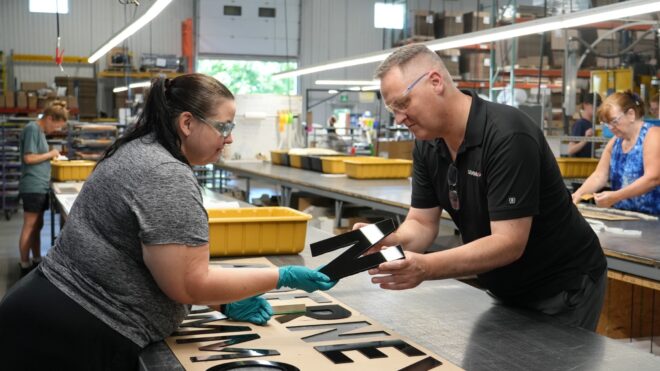
This process shows your customer that you respect their preparation while asserting your role as the signage expert.
How Gemini and Partner Portal Help You Protect Margin
It’s easier to manage spec-smart customers when you have a manufacturer partner that understands both the technical and business sides of each project. Gemini’s Partner Portal is built specifically to help sign shops streamline quoting, get more information on materials and processes, and track jobs.
When you receive an AI-generated signs, you can:
- Use Partner Portal to build quotes. Enter the sign specifications and materials you recommend instead of copying the AI-generated specifications, then leverage quoting tools to see realistic pricing and lead times.
- Collaborate with Gemini’s experts. Through the Help & Support panel, you can ask clarifying questions and request guidance on non-standard specifications, ensuring you’re not guessing on material combinations or mounting approaches.
- Centralize communication. Keep messages, artwork approvals, and quote revisions in one place so you can reference them if the client’s expectations shift or if you need to justify changing orders.
Beyond Partner Portal itself, Gemini’s signage products and resources library give you information on products, mounting methods, and product details you can use to validate or refine AI suggestions. That combination (fast quoting plus deep expertise) helps you build a spec you can stand behind and a price that reflects the real value of your work.
Turning Spec-Smart Customers into Long-Term Partners
The goal isn’t to push back on every AI-generated idea. It’s to shape those ideas into projects that work for both the customer and your business. A few practical approaches:
- Position yourself as the translator. Let customers know you appreciate their research and that your role is to help make a plan to account for local conditions, materials, and installation methods.
- Anchor conversations in outcomes. Instead of debating each specification detail, keep returning to what the sign must achieve: visibility, brand presence, compliance, and lifespan. From there, show how your recommended materials and design deliver those outcomes more reliably.
- Use examples and social proof. Reference past projects where you refined a client’s initial concept and delivered better results, especially dimensional signage work that performed well in the field.
- Be transparent about cost drivers. Explain which elements of the AI-generated sign that add cost or complexity and offer alternatives that preserve the look while protecting their budget and your margin.
Handled well, spec-smart customers can become some of your most loyal clients. They value information, appreciate clear guidance, and are often more willing to invest in better materials and designs once they understand the trade-off. To learn more, visit the Partner Portal.
FAQs
How should my shop respond when a customer brings in AI-generated signage specs?
Help your customers understand that the AI-generated sign is a great conception, not a finished plan. Walk through the document with the customer, confirm their goals and site conditions, then explain where you need to adjust materials, mounting, or sizing to meet real-world requirements. Use tools like Gemini’s Partner Portal to validate pricing and timelines based on your updated, expert-informed spec.
How can I protect my margins when sign specifications are more complex than the customer realizes?
Build a quoting process that accounts for design time, site review, and any custom fabricated required. Be transparent about these steps and show how they reduce risk and rework. Instead of absorbing extra labor as “free” service, include it in your scope and quote, backed by clear explanations of the value you’re providing.
What’s the best way to push back on unrealistic AI-driven specifications without losing the customer?
Lead with alignment instead of disagreement. Acknowledge that the AI-generated sign shows what they are looking for, then explain where the concept doesn’t match their specific site or brand. Offer a side-by-side comparison: the original AI sign and your adjusted version, with short notes on cost, durability, and installation. This keeps the conversation collaborative.
How can Gemini support me when I’m unsure whether a sign is practical or profitable?
As a Gemini partner, you can use Partner Portal’s Help & Support features to ask questions about material combinations, mounting scenarios, or custom requests. Gemini’s Product Guide, resource library, and large project support teams are designed to help you with the right-size specs before you quote, so you protect your margin and keep the job feasible.
Can I use Partner Portal to streamline communication around specifications changes and approvals?
Yes. Partner Portal centralizes quotes, orders, artwork approvals, and message history for each project. When you need to revise sign specifications or explain a change order, you can reference prior messages and documents instead of juggling email chains. That makes it easier to show customers how the project evolved, and why the final price accurately reflects the work involved.
How do I turn spec-smart customers into long-term, repeat clients?
Focus on education and consistency. Each time a spec-smart customer comes to you, take a few minutes to explain what worked well in their AI-generated sign concept and where your expertise improved the outcome. Over time, they’ll start coming to you earlier in the process, relying on your guidance before they finalize specs, especially when they see that your recommendations lead to smoother installs and better-looking signs.